
Key takeaways
- You don’t need a shopfront to show up on Google. You need a correctly set up profile, a website that names the towns you serve, and steady reviews.
- If customers don’t come to you, Google wants your address removed from your Business Profile. Add up to 20 service areas instead.
- A useful page for each main town you cover helps Google match you to searches like “electrician Papamoa”.
- Reviews that mention the suburb, plus consistent listings in NZ directories, build the trust Google looks for.
Plenty of great Kiwi businesses run from a home office, a spare room or the front seat of a ute. Local SEO without a shopfront is absolutely doable, but it works a bit differently, and most owners I talk to have never been told how. Local SEO just means helping Google show your business to people searching nearby.
In this post, I’ll show you why it feels harder when there’s no shop, how to set up your service areas properly, and the simple website, review and listing habits that help you turn up in the towns you actually work in.
Why local SEO without a shopfront feels harder
Google decides who appears in local results using three things: relevance, distance and prominence. In plain English, that’s how well you match the search, how close you are to the person searching, and how well-known and trusted you are. You can read Google’s own explanation in its tips to improve your local ranking.
Now, here’s the thing. When there’s no shop for customers to visit, distance works against you a little in the towns further from your base. A cleaner based in Hamilton won’t automatically pop up for someone searching in Cambridge.
So you make up the gap with the two things you can control: relevance and prominence. That’s what the rest of this post is about.
Set your service areas properly
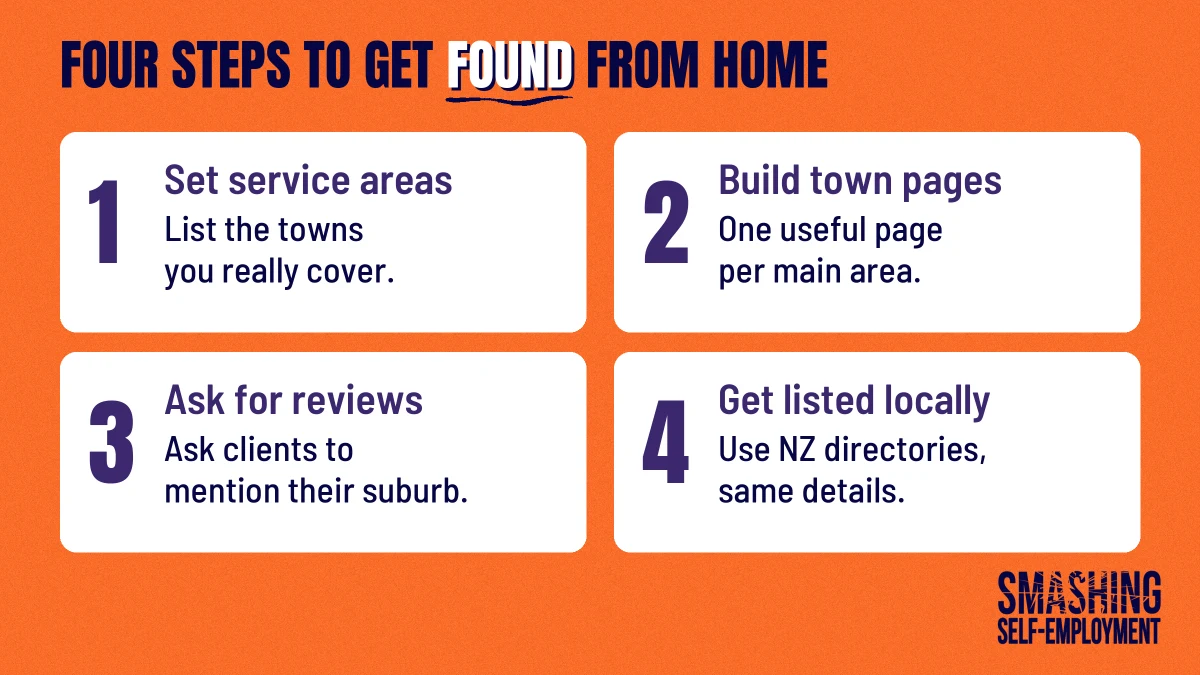
Start with your Google Business Profile, the free listing that shows in Google Maps and search. Google is clear on this one. If you don’t serve customers at your business address, you should remove the address and list your service areas instead.
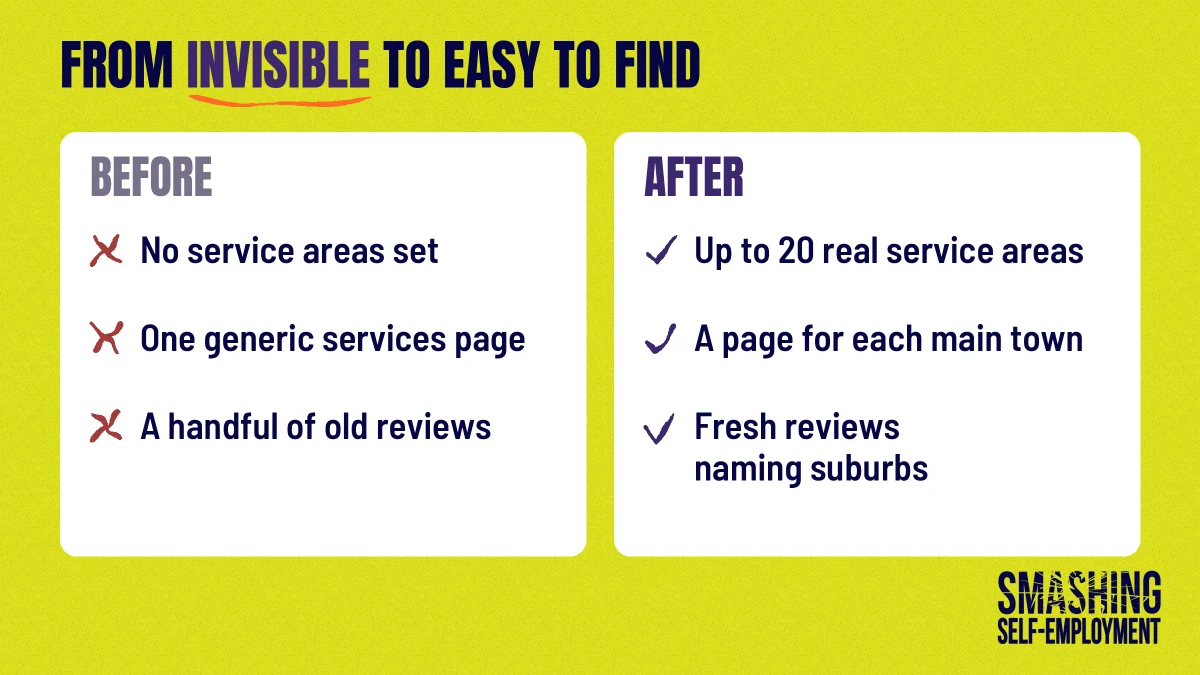
According to Google’s service area guidelines, you can add up to 20 service areas by town, postcode or region, but not as a radius around your house. Your overall area shouldn’t stretch much beyond about two hours’ drive from your base. Be honest here. Listing every town in the North Island won’t help, and it goes against Google’s guidelines.
Please don’t be tempted to use a PO box or a mate’s office address to fake a shopfront either. Google says a business without permanent signage at its address isn’t eligible to be listed as a shopfront. Losing your whole profile to a suspension is a far bigger headache than ranking a bit lower.
Read next: How to Set Up Your Google Business Profile in NZ or Australia
Give each main town its own page
Your Business Profile tells Google where you work. Your website backs it up. If your site only says “we service the wider region”, Google has very little to go on.
The fix is a simple page for each of your main towns or suburbs. I’d start with your top three, not all twenty. Each page should be genuinely useful to someone in that place: the jobs you do there, how quickly you can get there, any travel charges, and a couple of photos of real work nearby.
To be honest, the lazy version (one page copied ten times with the town name swapped) doesn’t help anyone. Readers spot it, and it does little for your rankings. Write each page like you’re talking to a customer from that town.
If writing pages and sorting out the technical bits isn’t your thing, that’s exactly what my SEO help for small businesses covers.
Ask for reviews that mention the suburb
Reviews are one of the biggest trust signals you’ve got. Google says more reviews and positive ratings can improve your local ranking, and that replying to reviews helps your business stand out.
When you finish a job, send a short text with your review link. Something like: “Thanks so much, Sarah. If you’ve got a minute, I’d love a quick Google review. Feel free to mention what we did and whereabouts you are.” Don’t write the review for them. Just a gentle nudge is enough.
Then reply to every review, good or bad. It takes two minutes, and future customers really do read them.
Get listed where Kiwis look
Prominence also comes from how often your business shows up around the web. Google mentions the number of sites linking to you as part of it. You don’t need fancy link building. You need consistent listings in the places New Zealanders already use.
Good free or low-cost starting points include Finda, NoCowboys, Builderscrack (for trades), Neighbourly and your local chamber of commerce. Use exactly the same business name, phone number and website on every one. Small mismatches confuse Google more than you’d think.
Local links count too. Sponsoring the kids’ rugby club or the school gala often earns a mention on their website, and that’s a genuine local signal.
How long until you see results?
I’d love to say it’s instant, but it isn’t. Service area changes can take a couple of days to show, and new town pages and reviews usually take a few months to make a noticeable difference.
The good news is that most of this is a one-off setup, followed by a small habit. Half an hour a week asking for reviews and updating your profile adds up nicely over time.
Read next: Marketing Tips for Time-Poor NZ Business Owners
Frequently asked questions
Should I show my home address on Google?
Not if customers don’t visit you there. Google asks service area businesses to remove their address and list service areas instead. It also keeps your home address private, which most people prefer anyway.
Can I rank in a town I’m not based in?
Yes, but it takes more work. Add the town as a service area, create a useful page about your work there, and ask customers from that town for reviews. Expect to rank more easily closer to home.
Do I need a website, or is my Google profile enough?
A Business Profile alone can bring in enquiries, but a website gives Google far more to work with. Even a simple site with a page for each main town gives you a real advantage.
Is a virtual office a good workaround?
I wouldn’t risk it. Google says a business without permanent signage at its address isn’t eligible as a shopfront. If customers don’t come to you, list yourself as a service area business.
This week, log into your Google Business Profile, check your address settings and add your top five service areas. If you’ve got ten minutes left, text your last three happy customers and ask for a review.
And remember, do a little marketing every day. Being consistent is the key to marketing success.
If you’d like a hand getting found in the towns you serve, email me at help@smashingselfemployment.com and I’ll point you in the right direction.