
Key takeaways
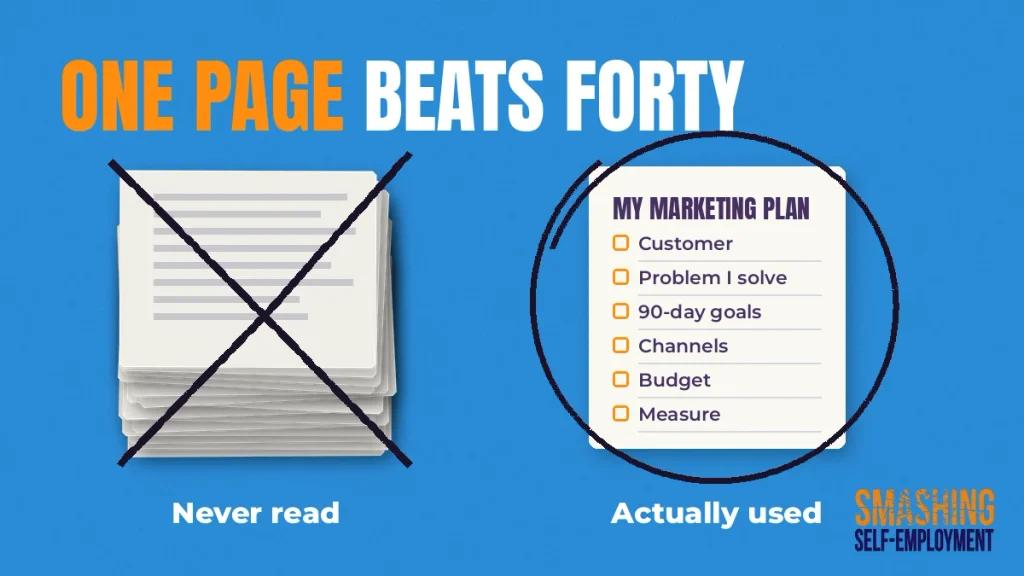
- A simple marketing plan fits on one page, and that’s exactly why you’ll actually use it.
- It only needs to answer a handful of questions: who you help, what you want, how they’ll find you, what you’ll spend and how you’ll know it’s working.
- Set goals that fit the time and money you really have, not the ones you wish you had.
- Grab the free one-page template below, fill it in over a coffee, and review it once a month.
If you’ve ever sat down to write a marketing plan and given up somewhere around page three, you’re in good company (been there, done that). Most small business owners in New Zealand know they should have a plan. Very few have one they actually look at.
The good news is that a simple marketing plan works better than a big one for most small businesses. In this guide I’ll show you why one page is enough, what that page needs to cover, how to set goals that match your time and budget, and I’ll give you a free NZ template you can fill in today.
I’ve written plenty of long marketing plans over the years, back in my agency days and since. The ones that made the biggest difference were never the thickest. They were the short ones that got pinned above the desk and checked every week.
Why a one-page marketing plan beats a 40-page document you’ll never read
The classic marketing plan is built for big companies. It has a market analysis, a competitor matrix, a SWOT, personas, a channel strategy and a budget spreadsheet with twelve tabs. That makes sense when a team of ten has to agree on it. It makes a lot less sense when the team is you.
And for most of us, the team really is just us. There are 612,000 businesses in New Zealand and 97% of them are small businesses, with fewer than 20 staff. Around 448,000 of those have no employees at all. If that’s you, nobody is going to read a 40-page plan, including you.
Here’s the thing though. Writing your plan down still matters, a lot. CoSchedule’s 2022 marketing strategy research found that marketers who document their strategy were 414% more likely to report success, and those who plan proactively were 331% more likely. The win comes from writing it down and looking at it, not from how long it is.
A one-page plan gives you the best of both. It’s quick to write, so you’ll actually finish it. It’s short enough to keep in view, so it shapes what you do on a busy Tuesday. And it’s easy to update when something changes, which in a small business is most months.
Think of it less like a business document and more like a map. You don’t need every street. You need to know where you’re heading, the main roads to get there, and roughly how much fuel you’ve got.
The handful of things your plan really needs to cover
Strip a marketing plan back to the bones and it answers six questions. If yours answers these clearly, it’s doing its job.
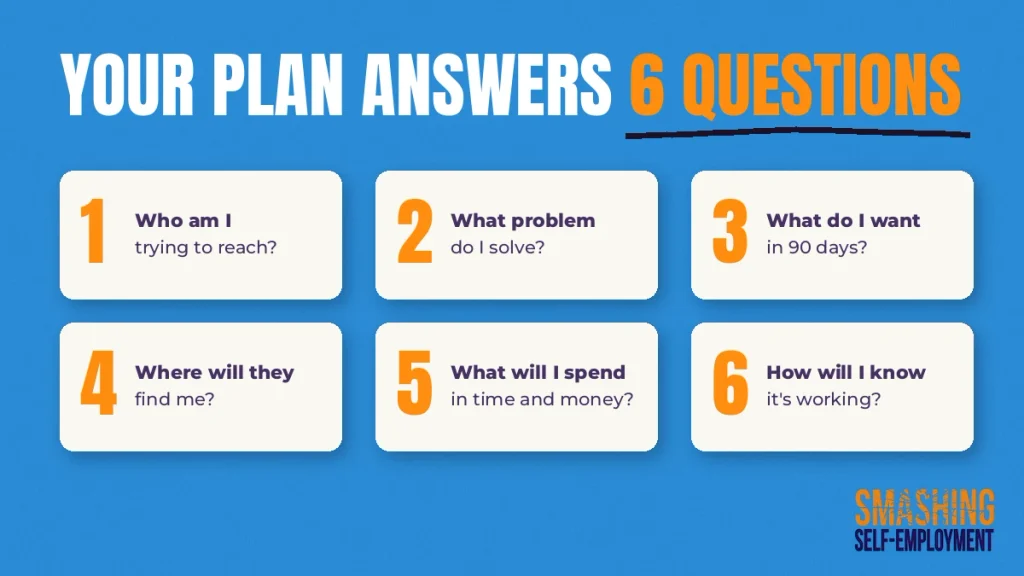
1. Who are you trying to reach? Describe your ideal customer in a sentence or two. Not “everyone in Auckland”, but something like “busy homeowners in the North Shore who want a bathroom renovated without the stress.” The sharper this is, the easier every other decision becomes.
2. What problem do you solve for them? In plain words, why should they pick you? This is your message. If you can’t say it in one sentence, your customers won’t be able to either.
3. What do you want to achieve? One to three goals for the next 90 days. More on this in the next section, because it’s where most plans go wrong.
4. Where will they find you? Pick three or four channels, no more. For a lot of NZ service businesses that’s a Google Business Profile, a simple website, a facebook page and an email list. Maybe Google Ads if there’s budget. You don’t need to be everywhere, you need to be consistent where you are.
5. What will you spend? Both money and time. A plan with no budget is a wish list, and time is usually the tighter of the two.
6. How will you know it’s working? One or two numbers you’ll check each month, such as enquiries, bookings or reviews. Even something as simple as asking every new customer how they heard about you counts. The US Small Business Administration makes the same point, suggesting that tracking can be as simple as asking new customers where they learned about your business.
That’s it. You’ll notice there’s no SWOT analysis and no 30-slide persona deck. If you want those later, great, but they’re not what gets the phone ringing.
Setting goals that match your time and budget
This is where I see most plans fall over. The goals look great on paper, “double our leads, post every day, launch a podcast”, and then real life turns up. A big job lands, a team member is off sick, and the plan quietly goes in a drawer.
So start with an honest look at what you’ve actually got. How many hours a week can you genuinely give to marketing? Two? Five? And how much money can you set aside each month without it hurting?
On the money side, there’s no magic number. A guide from the US Small Business Administration quotes figures showing average marketing spend sits at around 7.9% of revenue, but it varies a lot by industry, and a newer business usually needs to spend more to get known. Treat percentages as a rough guide, not a rule. What matters more is picking a figure you can keep up for a few months, because marketing that starts and stops rarely works.
Then set goals that fit those limits. Here’s roughly how that looks in practice:
| What you’ve got | A realistic 90-day goal |
|---|---|
| 1 to 2 hours a week, little or no budget | Get 10 new Google reviews and post one helpful update a week on your Google Business Profile |
| 3 to 5 hours a week, a few hundred dollars a month | Send a monthly email to past customers and win 3 repeat jobs from it |
| More time, a proper monthly budget | Run a focused Google Ads campaign and grow enquiries by 20% |
Keep each goal specific, measurable and time-bound. “Get more customers” isn’t a goal. “Win five new bookings a month from Google by the end of March” is.
And keep the list short. One to three goals is plenty. Every goal you add pulls time away from the others, so it’s far better to nail one than to half-do five.
If you’re not sure what things cost, I’ve broken down realistic numbers in Google Ads Cost in NZ: What to Budget in 2026 and How Much Does a Website Cost in NZ? 2026 Prices.
A free one-page simple marketing plan template (NZ)
Here’s the template I usually use with small business clients. Copy it into a document, a notebook or the back of an envelope, and give yourself 30 minutes to fill it in. Don’t overthink it. A rough plan you use beats a perfect one you don’t.
| Section | What to write | Your answer |
|---|---|---|
| My ideal customer | Who they are, where they are, what they need. One or two sentences. | |
| The problem I solve | Why they should choose you, in one plain sentence. | |
| My 90-day goals | One to three specific, measurable goals with a date. | |
| My main channels | The two or three places customers will find you. | |
| Key dates | NZ busy and quiet periods for your trade, e.g. the January shutdown, end of financial year on 31 March, school holidays, Christmas. | |
| Monthly budget | Dollars per month (excluding GST) and hours per week. | |
| Weekly actions | The small things you’ll do every week, e.g. ask for two reviews, send one email. | |
| How I’ll measure it | One or two numbers you’ll check monthly, e.g. enquiries, bookings, reviews. | |
| Review date | When you’ll sit down and check progress. Put it in your calendar now. |
A quick example
To show how this looks filled in, here’s a version for a made-up Wellington bookkeeper:
- Ideal customer: Sole traders and small trades businesses in Wellington who hate doing their books.
- Problem I solve: I keep your Xero tidy every month so GST time is stress-free.
- 90-day goals: Win four new monthly clients by 31 March. Get to 25 Google reviews.
- Main channels: Google Business Profile, referrals from two local accountants, a monthly email.
- Budget: $150 a month, three hours a week.
- Weekly actions: Ask every happy client for a review. Post one tip on Google Business Profile. Have coffee with one referral partner a fortnight.
- Measure: New enquiries and where they came from.
- Review: First Monday of each month.
That fits on one page with room to spare, and every line tells you what to actually do.
How to keep it alive
The plan only works if you look at it. Stick it somewhere you’ll see it, the wall above your desk or the first page of your notebook. Set a monthly reminder to spend 20 minutes checking your numbers and tweaking what isn’t working. Every 90 days, set fresh goals.
If your channels include email or local search, these guides will help you put the plan into action: Email Marketing Tips for NZ Small Businesses, How to Improve Local SEO for Your NZ Business and How to Set Up Your Google Business Profile in NZ.
Frequently asked questions
How long should a small business marketing plan be?
One page is enough for most small businesses. If it answers who you’re targeting, what you want, where customers will find you, what you’ll spend and how you’ll measure it, it’s doing its job.
How often should I update my marketing plan?
Check it monthly and set new goals every 90 days. A quick 20-minute review each month keeps it relevant without turning it into a chore.
Is a marketing plan the same as a business plan?
No. A business plan covers the whole business, including finances, operations and funding. A marketing plan focuses on how you’ll find and win customers. If you need a full business plan, business.govt.nz has a free business plan template and video series.
How much should I spend on marketing?
There’s no single right answer. Pick a monthly amount you can keep up for at least three months, track what it brings in, and adjust from there.
Your next step
This week, block out 30 minutes, grab the template above and fill it in. Don’t aim for perfect. Aim for done, then stick it on the wall.
And remember, do a little marketing every day. Being consistent is the key to marketing success.
If you’d like a hand turning your one-page plan into something that brings in steady work, that’s exactly what our Strategic Marketing & Planning support is for.
If you’d like a hand getting your plan sorted, email me at help@smashingselfemployment.com and we’ll arrange a short chat.